
From Acrylic Sheet to Finished Set: A Walk Through Our Taishan Factory
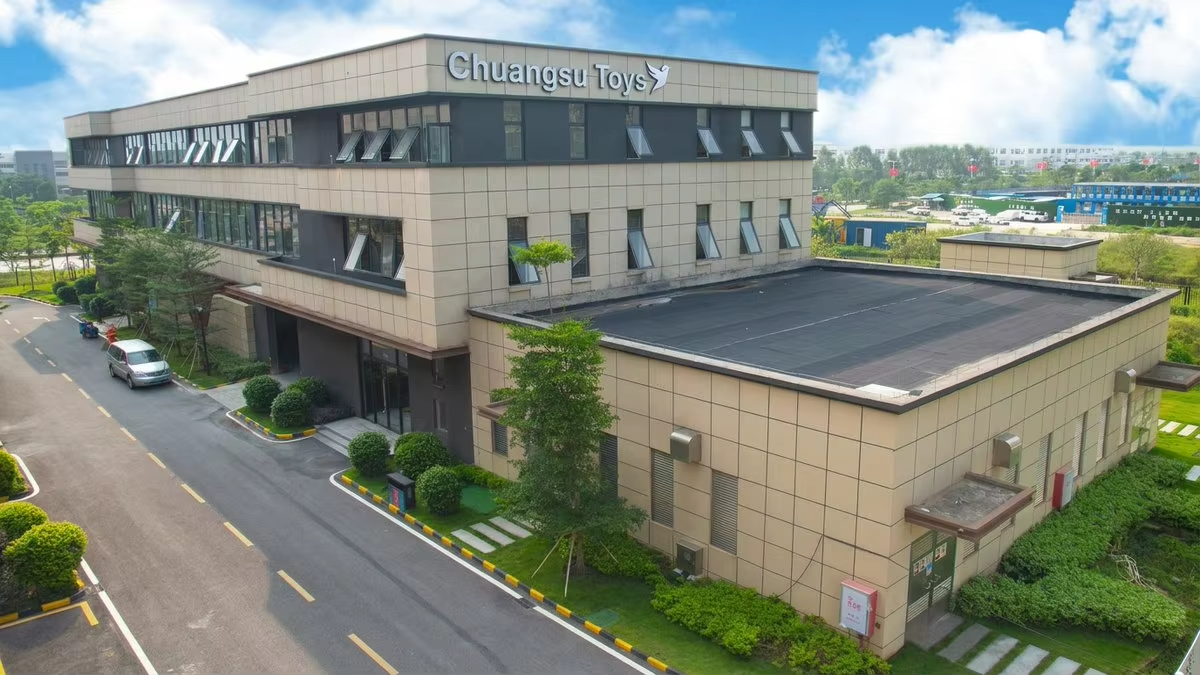
Follow one American mahjong set through all five CHUANGSU production lines — compounding, molding, laser engraving, automated coloring and mirror polishing — explained by the team that runs them.
Why We Open the Doors
Most buyers meet a mahjong factory only through a listing page. We prefer the opposite: every serious inquiry gets line photos, process notes and, on request, a live video walkthrough. This article is the standing version of that tour — the same one our engineers give.
The plant sits at Building 7, Zhongnan High-tech Industrial Park in Taishan, Guangdong: 3,600 square meters, five production lines, and an annual capacity of 240,000 sets with a 400,000-set peak. Here is what happens inside.
Line 1 — Compounding and Cutting
Everything starts as acrylic sheet, compounded to a controlled tone so reorders match first articles. Precision cutting turns sheet into tile blanks; dimensional checks here decide whether the rest of the process can hold tolerance.
Buyers rarely think about this line, yet it is where color consistency across seasons is won or lost. We keep retained samples of every compound batch for exactly that reason.
Line 2 — Laser Engraving
High-precision laser cells cut suit marks, characters, jokers and custom artwork. Automation matters less for speed than for repeatability: tile 8 of a suit looks like tile 88, on every set in the run.
Custom artwork is rasterized and test-engraved before approval. If a motif will not survive engraving cleanly, we say so at quoting — not after production.
Lines 3 and 4 — Coloring and Polishing
Automatic dispensing systems infill engraved lines with paint, including gold and silver effects. Machine infill beats hand work on evenness and wear life, which is why our colored marks keep their look after a season of club play.
Multi-stage polishing then brings the tile face to the gloss premium buyers expect. The mirror finish is not cosmetic padding; it is what makes tiles shuffle smoothly and resist visible scratching.
Line 5 — Assembly and Export Packing
The final line counts and matches tiles, pairs them with racks, pushers, dice and cases, and packs to the program: retail boxes, gift presentation or master cartons for wholesale.
This is also the last QC gate. A full-set audit compares the finished set against the approved sample before anything is sealed for export.
What It Means for Your Order
Because all five lines are under one roof, a change request — a Pantone shift, a deeper engraving, a different case — is a conversation between neighboring workshops, not an email chain across suppliers. That is the practical benefit of buying from a source factory.
If you would like the tour in person or on video, ask for it when you request a quotation. We answer within four business hours.